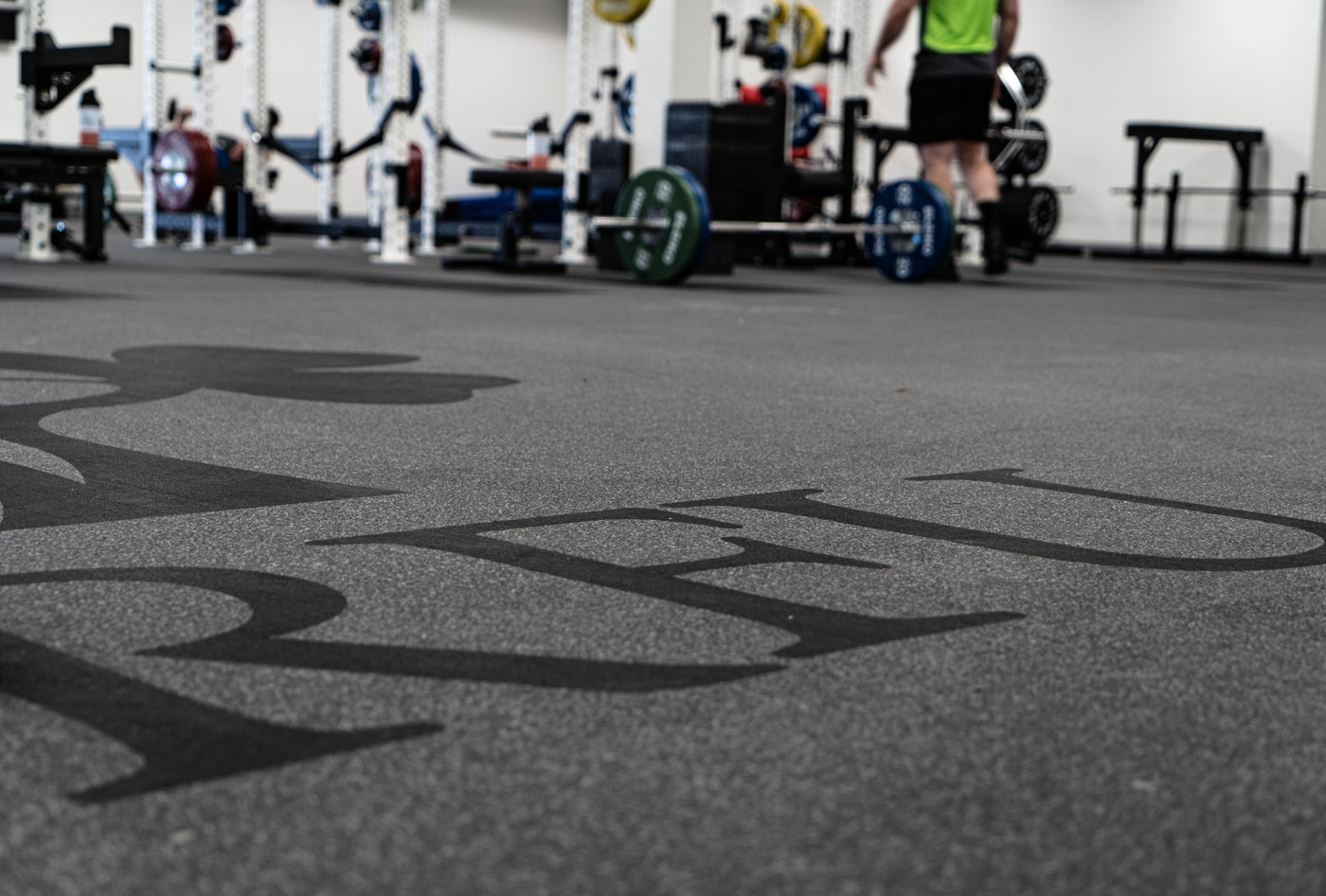
Gym flooring that survives
your heaviest session

Thickness is the decision that matters. Tell us the room and how you train, and we will point you at the right floor, the right quantity, and the fixings that go with it.

  • Drop-tested in Belfast
  • Trade pricing available

Trusted by the best

Step 1: What are you flooring?

Each route sets the calculator and filters the products below.

  • Hip Thrust Bench (Rubber tile) - BLK BOX

    Home & garage gym

    Bodyweight, cardio and dumbbells to 40kg. Protects concrete and keeps the noise down.

    15-20mm tiles

  • Barbell & drop zone

    Deadlifts, olympic lifting and dropped loaded bars. Needs depth or a platform.

    40mm+ tiles or a platform

  • Commercial gym floor

    Large areas, mixed zones, high footfall. Rolls for coverage, tiles for free weights.

    Rolls & tiles, quoted per project

  • BLK BOX Velocity Turf – BLK BOX

    Sled, sprint & turf

    Push and pull lanes, agility work and conditioning set into a rubber floor.

    Turf & track

Step 2 · Live calculator

How much will you need?

Enter the room, pick a thickness, and we work out tile count with a 5% waste allowance and the total cost. The answer carries through to the product page and the basket.

Floor
Area
Tiles needed
Est. total

Step 3 · Home & garage gym

Ordered by what they take, not by name

  • (42)

    Anti-Slip Gym Tile

    Anti-slip rubber tile for home gyms, PT studios and small group training. 15mm, 1m x 1m, no glue needed.

    €27,95
  • (4)

    Challenger Gym Tile

    High impact rubber tile for free weight and Olympic lifting areas. 20mm, 1m x 1m, 24dB sound reduction.

    €59,95
  • High Impact Gym Tile 30mm

    High impact rubber tile for free weight and Olympic lifting areas. 30mm, 24dB sound reduction.

    €49,95
  • (1)

    High Impact Gym Tile 40mm

    Dual-layer rubber tile with EPDM top for home gyms and commercial facilities. 40mm, 1m x 0.5m, no adhesive needed.

    Priced per project
  • Element Tile

    Anti-slip virgin rubber tile for functional fitness and cardio. 7mm, 1m x 1m, interlocking with no adhesive.

    €119,95
  • (2)

    Utility Gym Flooring Roll

    Rubber roll for free weight and lifting areas in home gyms and studios. 10mm, 1.25m x 10m.

    €568,95
  • Fusion Gym Flooring Roll

    Dual-layer rubber roll for multi-use functional training spaces. 15mm, 1.2m x 7.5m, 35.4% force reduction.

    Priced per project
  • Foundation Gym Flooring Roll

    Hard-wearing rubber roll for commercial gyms and performance centres. 15mm, 1.2m x 7.5m, 2.5mm EPDM top.

    Priced per project
  • Apex Roll

    Triple-layer roll with built-in shockpad for heavy lifting and strength training. 30mm, 1.2m x 7.5m.

    €2.369,95
  • Agility Turf

    Sled, sprint and conditioning turf with a 15mm pile. 2m wide rolls in 15m or 25m lengths.

    €1.495,95
  • Custom Turf

    Fully customisable turf for your facility that fits seamlessly with other BLK BOX flooring.

    Priced per project
  • Weightlifting Platform

    Varnished birch plywood centre with shock-absorbing rubber tiles in a laser-cut steel frame.

    €1.675,95
  • Inlaid Wooden Platform

    Marine-grade plywood platform that sits inside your rubber flooring. 18mm or 36mm, 1m x 2m.

    Priced per project
  • Anti-Slip Composite Platform

    MDF core with an anti-slip top layer, made to sit within rubber tiles. 17mm, 1m x 2m.

    Priced per project
  • Custom Inlaid Platform

    Made-to-order lifting platform, fully customisable and designed to sit flush with your flooring.

    Priced per project
  • Challenger Transition Strip

    20mm transition strip for Challenger tiles that removes the trip hazard at the edge. Connectors not included.

    €17,95
  • High Impact Transition Strip

    40mm rubber transition strip for High Impact tiles. A safe, seamless edge for busy training spaces.

    €50,95
  • Challenger Corner Ramp

    20mm rubber corner ramp for Challenger tiles. Removes floor bumps and trip hazards. Connectors not included.

    €59,95
  • (4)

    Gym Tile Connector

    Connector for High Impact 20mm and 30mm tiles. Keeps tiles in place and corners level.

    €1,95
  • Shockpad Underlay

    Impact-absorbing underlay for commercial gyms. Reduces noise and vibration and can raise floor height.

    Priced per project
  • Adhésif Stauf

    Adhésif bi-composant de qualité professionnelle conçu pour une installation sécurisée d...

    €125,95

Finish the job

Trims, connectors and adhesive sit in their own strip instead of competing with tiles in the main grid.

If you only remember one thing

Thickness is about what you drop, not how heavy you lift

A 200kg squat on 15mm rubber is fine. A 60kg bar dropped from the hip on the same floor will crack the slab underneath. Match the floor to the worst impact it will take, zone by zone.

  • 15mm

    Nothing gets dropped

    Cardio machines, mat work, dumbbells returned to the rack. Protects the slab and cuts noise.

  • 20-30mm

    Controlled lowering

    Racks, benches, kettlebells set down rather than dropped. The right floor for most of a room.

  • 40mm+ or a platform

    Loaded bar hits the floor

    Deadlifts, cleans, snatches. Only needed where the bar actually lands, usually 4-8m².

Before you order

Eight things people wish they had checked

Most home gym regrets are about the room, not the kit. Work through these before you buy anything.

  1. 01

    Ceiling height

    Measure to the lowest obstruction, not the highest point. An overhead press needs your standing reach plus about 30cm, and a pull-up bar needs the same again.

    2.4m clear is the threshold
  2. 02

    Floor build-up

    Rubber adds height and takes it off your ceiling clearance. It also changes the door swing if the floor runs up to a doorway.

    Allow 15-40mm
  3. 03

    What you will drop

    Dropping a loaded bar is the one thing that decides your flooring. Everything else can sit on 15mm.

    40mm or a platform
  4. 04

    Noise and neighbours

    Impact noise travels through a structure, not the air. Acoustic underlay under rubber does more than thicker rubber alone.

    Underlay first
  5. 05

    Delivery access

    Racks ship in long sections and plate sets are heavy. Check gates, stairs, turns and whether a pallet can get to the door.

    Measure the tightest turn
  6. 06

    Power and light

    Cardio machines with screens need a socket. Good overhead light matters more than people expect for barbell work.

    One double socket minimum
  7. 07

    Storage from day one

    Plates and dumbbells on the floor shrink a room fast. Wall storage buys back the training footprint.

    Plan wall space
  8. 08

    Room to grow

    Most people add a bar, plates or a machine within a year. Leave a metre spare rather than filling the room on day one.

    Keep 1m clear

Real builds

Over 4,000 home gyms fitted out

Garages, spare rooms, lofts, offices and outbuildings across the UK and Ireland. Send us your room dimensions and we will send back a layout.

Project gallery →
  • Garage build
  • Spare room build
  • Office gym build

Common questions

Home gym equipment, answered

What flooring do I need for a home or commercial gym?

Choose gym flooring from the training load and the subfloor. Rubber tiles suit strength and free-weight zones, rolls provide a more seamless surface across large areas, turf supports sled and agility work, and platforms create dedicated lifting zones. Commercial gyms often combine these rather than using one surface everywhere.

What gym flooring works for a home or garage gym?

BLK BOX gym flooring suits home gyms, garage gyms and commercial facilities, and for most home gyms the Anti-Slip Gym Tile is a top choice. Each tile is 1m x 1m x 15mm, and the modular design fits asymmetrical spaces and can be expanded later. The tiles can be lifted or moved without damaging your existing floor. For free-weight and Olympic lifting areas, use the 20mm Challenger tile, joined with connectors so no adhesive is needed. The 10mm Utility roll is another option, but it is fitted with adhesive on a level, prepared surface.

Which flooring suits a commercial gym?

The 15mm Foundation roll is built for high-traffic commercial gyms, independent facilities and sports performance centres. It has a hard-wearing 3mm top layer over a 12mm shock-absorbing base. For multi-use functional spaces, the 15mm Fusion roll has a slightly softer feel underfoot. Shockpad Underlay fitted beneath the floor adds shock absorption and can raise the finished height. For a branded lifting area, the Foundation Inlaid Waterjet Platform has custom waterjet-inlaid branding. It is designed for permanent installation and backed by a 5-year warranty.

How do I clean the flooring and replace damaged areas?

Rubber flooring can be vacuumed and mopped with warm water and a neutral-pH cleaner; avoid machine cleaning and solvent-based cleaners on rubber gym tiles. Turf should be vacuumed regularly and spot-cleaned. Modular tiles can make local replacement easier, but confirm colour and batch availability before assuming a future replacement will be visually identical.

How do I choose flooring thickness for my training area?

Thickness should reflect impact, dropped loads, acoustic requirements and the subfloor. Lighter general training can use thinner products, while heavy free-weight and lifting zones need more impact protection. Use tested product data where available rather than choosing thickness from appearance alone.

Should I choose rubber tiles, rolls, turf or a platform?

Use tiles where impact protection and replaceable modular sections matter, rolls where you want a continuous surface over a larger area, turf for sleds and conditioning, and a platform for concentrated weightlifting. The best facility layout can use several flooring types to match different training zones.

Can the floor be loose laid or does it require adhesive?

Installation varies by product and subfloor. The 40mm High Impact Tile and 20mm Challenger Gym Tile can be connected with five recommended connectors per tile, and the 30mm High Impact Tile with seven, or tiles can be professionally bonded after subfloor preparation. Rolls such as the 10mm Utility roll are fitted with adhesive, so the installation specification should be checked for the exact surface.

What should I check about my existing floor before choosing gym flooring?

Check the subfloor material, level, moisture condition, structural suitability and existing floor finish before specifying gym flooring. The installation method can change depending on whether a tile is connector-laid, loose laid or bonded, so confirm the chosen product against the actual base floor.

Can I use different flooring types in lifting and conditioning zones?

Yes. A gym can use impact tiles or platforms in lifting areas, rolled flooring in general strength zones and turf in conditioning lanes. Plan the transitions so floor heights, trip edges and equipment movement are controlled between surfaces.

What tested information is available about impact noise for this flooring?

Use product-specific acoustic data where it exists. The 40mm High Impact Gym Tile lists 61% shock absorption tested to EN14808 and 24dB sound reduction certified to EN ISO 17025:2005. Test data is listed on each product page, so check the figures for the exact tile or flooring you choose.

How should I finish edges at doors and changes in floor height?

Use compatible transition strips, ramps or edging where the flooring meets a doorway or a different floor height. Match the accessory to the finished flooring thickness so the edge is supported and the change in level is clearly controlled.

How much extra flooring should I allow for cuts and room obstacles?

Allow at least 10% extra material where the selected flooring calculator recommends it, particularly for cuts, obstacles and installation waste. Complex rooms can need more, so use the final layout rather than ordering exactly the measured net floor area.

What information do I need to get a gym flooring quote?

Provide the room dimensions, subfloor type and condition, training zones, expected dropped loads, acoustic requirements, door thresholds and any pillars or fixed obstacles. For custom layouts, also include turf, platform, colour and branding requirements so quantities and transitions can be planned together.

Does the flooring quote include preparation, delivery and installation?

Do not assume the material quote includes floor preparation, fitting materials, delivery and installation. Ask for an itemised flooring quote that separates product area, connectors or adhesive, transitions, subfloor work, logistics and installation.

What flooring should go under a squat rack?

Match the floor to the weights you lift at the rack. For busier lifting areas, use the 20mm Challenger or the 40mm High Impact tile. Both are designed for free-weight and Olympic lifting areas with high footfall, absorb shock and noise, and protect the floor below. For lighter home training, the Anti-Slip Gym Tile suits light to moderate free weights. For a dedicated Olympic lifting area, the Inlaid Wooden Platform is designed to integrate with surrounding rubber flooring and comes in 18mm or 36mm marine-grade plywood. Check the thickness against the equipment you use on it, as flooring that is too thick can affect stability during heavier lifts.

What are turf and track surfaces used for?

Turf and track flooring are designed for speed, agility, and conditioning work. Common uses include:

  • Sled training and sprinting – High-durability surfaces withstand repeated use.
  • Functional and conditioning exercises – Provides stability and grip for diverse workouts.
  • Multi-use gym spaces – Seamlessly integrates with other flooring types for a professional finish.
How does flooring contribute to gym safety?

The right flooring enhances safety by:

  • Providing a stable, non-slip surface to reduce injury risk.
  • Absorbing impact to protect joints and muscles during training.
  • Shielding equipment and subfloors from heavy weight drops.
What is performance flooring in gyms?

Performance gym flooring is designed to enhance athletic output by providing the right balance of shock absorption, energy return, and stability. Performance flooring is commonly used in strength & conditioning gyms, functional fitness spaces, and high-performance training environments.

What is specialist flooring?

Specialist flooring includes tailored solutions for specific training environments, such as:

  • Athletic tracks with optimised shock absorption for sprinting.
  • Studio flooring with cushioned support for group fitness classes.
  • Acoustic flooring to reduce impact noise in weightlifting and functional training zones.